
Les techniques théâtrales au service de la communication orale en FLS


En didactique des langues, la perspective actionnelle présente l’apprenant comme un acteur social qui réalise des tâches d’interaction avec divers interlocuteurs. Cet article analyse comment les techniques théâtrales facilitate interactions in français langue seconde (FLS) tant en classe qu’auprès de la communauté locale. Il s’appuie sur une expérience universitaire canadienne autour d’un cours de communication orale dont le projet principal consiste en un reportage comprenant des entretiens et des présentations.
🎭 Introduction
La communication orale requiert une prise en compte à la fois du langage verbal et non verbal ainsi que du contexte social des échanges. La Linguistic accuracy n’est qu’un aspect parmi d’autres, d’où la nécessité de proposer aux apprenants un cadre de communication qui mobilise la personne dans sa globalité. Les techniques théâtrales sont explorées pour rendre les more authentic interactions et productives. Après une présentation théorique, l’article décrit un projet pédagogique centré sur un reportage et les tâches d’entrevue et de présentation finale, ainsi que leur évaluation.
📚 Cadre conceptuel
La langue est souvent perçue comme un système externe à la personne, ce qui minimise le rôle fondamental du bodywork et des rapports sensoriels dans l’apprentissage. Le mouvement corporel précède et donne sens à la parole, en s’appuyant sur l’ancrage sensori-moteur de l’interaction. L’éducation au senti favorise la présence et la disponibilité dans le jeu improvisé.
En FLS, les techniques théâtrales sensibilisent les apprenants à l’usage du corps dans la communication, répondant aux exigences du Cadre européen commun de référence (CECR) en matière de multimodalité et contextualité. Elles encouragent également la construction identitaire, l’ouverture à l’Autre et la collaboration dans les tâches langagières et sociales.
La pratique théâtrale consiste en un espace collectif imaginaire où le corps en mouvement permet d’expérimenter la langue par étapes performatives et collaboratives. Les jeux dramatiques non verbaux et d’improvisation génèrent un premier réseau empathique et communicationnel, base solide pour la parole et l’ouverture interculturelle essentielle à la communauté d’apprentissage que constitue la classe de FLS.
🌍 Contexte de pratique
Dans le cadre universitaire, les étudiants, issus de disciplines variées, se préparent à des interactions sociales futures en partageant des expériences passées ou actuelles. Leurs sujets abordent des thèmes identitaires et personnels, rendant l’engagement au projet plus sincère. L’objectif est de développer des compétences d’oral interactions en français, notamment lors des entrevues et des présentations, dans un contexte sécurisant grâce aux exercices inspirés du théâtre.
La construction d’une communauté de classe démarre dès le début par des jeux non verbaux, préverbaux et verbaux qui renforcent trust, mutual knowledge et la conscience du langage corporel. Ces compétences sont essentielles, tant en classe que dans la vie quotidienne, et les techniques théâtrales favorisent la confiance nécessaire avant l’interaction avec la communauté francophone locale.
💡 Le projet de reportage
Ce projet, inscrit dans une approche actionnelle, vise à développer des compétences linguistiques et socioculturelles à travers des interactions réelles et pédagogiques qui co-construisent le sens. L’apprenant interagit avec several social groups, dont la communauté francophone locale et ses pairs, en menant un projet réparti en plusieurs étapes :
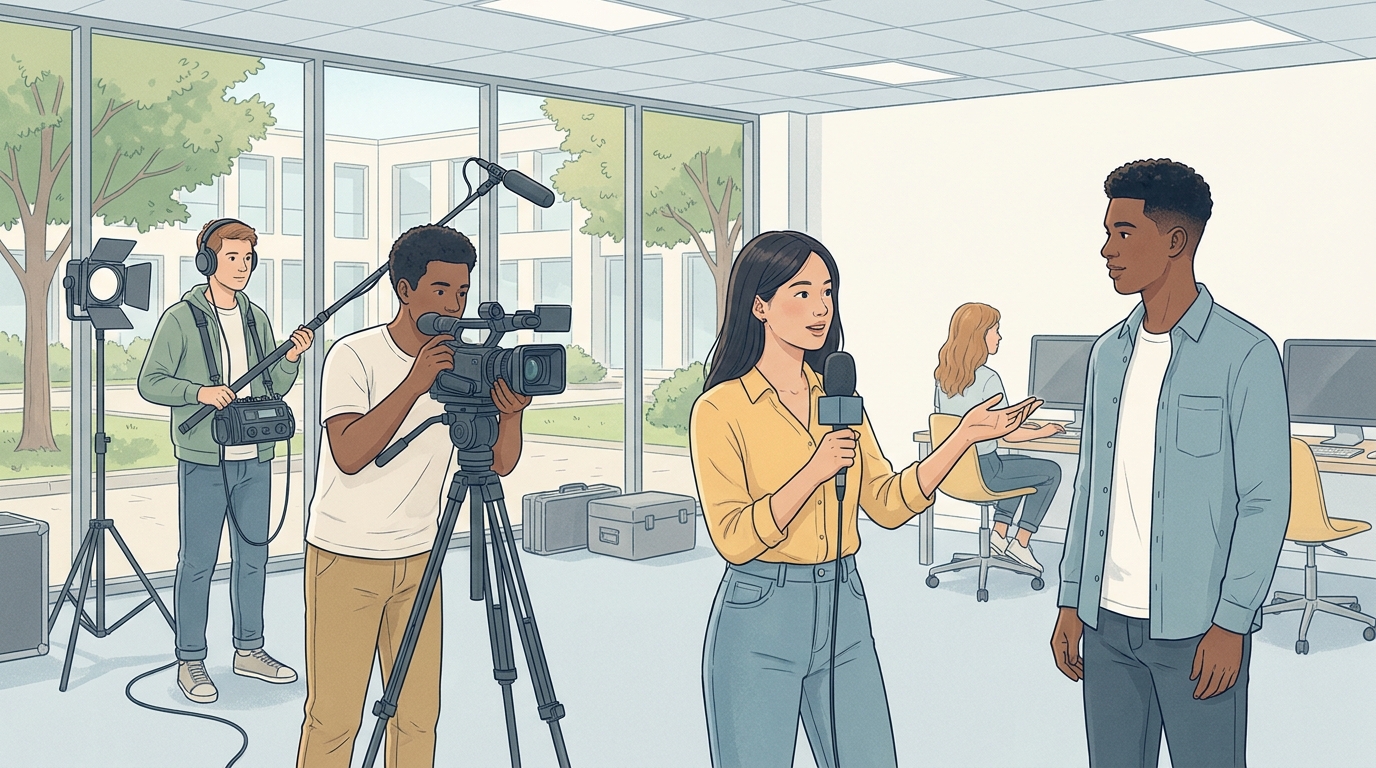
- Présentation vidéo initiale du sujet et de la personne à interviewer ;
- Transcription, analyse de l’entrevue ou sondage, création d’une fiche vocabulaire ;
- Présentation et discussion du projet en classe.
Ces étapes proposent des tâches authentiques qui combinent interaction hors et en classe.
L’entrevue
L’étudiant doit identifier, contacter et rencontrer une ressource locale pour une entrevue en personne, permettant un enregistrement à transcrire. Parfois, un questionnaire est réalisé auprès de pairs. Les apprenants sont ainsi acteurs d’une tâche authentic communication et de collecte de données. En classe, ils répètent les compétences langagières, vocales et physiques par des jeux de rôle improvisés, préparant l’Formal interview avec son registre, intonation et posture adaptés.
La présentation finale
L’objectif est de partager les résultats de recherche dans une performance communicationnelle globale et interactive, au sein d’une communauté d’apprentissage consolidée. La présentation est préparée collectivement via des activités théâtrales travaillant la respiration, la projection de la voix et l’articulation, avec des virelangues et exercices rythmiques.
Ces jeux créent un sentiment d’appartenance et d’empathie entre présentateurs et auditoire. Les étudiants travaillent en panels, partagent des anecdotes personnelles et des objets symboliques, favorisant l’échange sincère et la cohésion du groupe. Ils étudient aussi des modèles de conférences TedX en français pour optimiser l’impact visuel et interactif.
Chaque séance commence par un échauffement suivi d’une méditation, renforçant la solidarité avant les présentations. Les auditeurs participent activement en prenant des notes et posant des questions lors des discussions guidées.
Évaluation
L’évaluation de la présentation prend en compte la parole (prononciation, débit, intonation) et la qualité de l’interaction à plusieurs niveaux. L’examen final comporte une improvisation de groupe inspirée des projets et une rétroaction individuelle enregistrée, combinant synthèse et réflexion critique. Cette démarche valorise également la conscience du langage corporel, souvent soulignée spontanément par les apprenants.
Au fil du projet, l’apprenant assume son rôle d’acteur social, reliant micro-communauté d’apprenants et communauté locale. Les techniques théâtrales soutiennent ainsi l’apprentissage de compétences sociales et communicationnelles cohérentes avec la perspective Citizen action.
💬 Conclusion
Le projet de reportage, fidèle à la perspective actionnelle plaçant l’interaction au cœur de l’apprentissage, soutient une compétence globale de communication basée sur la collaboration dans la communauté de classe. Les techniques théâtrales concrétisent et renforcent cette dynamique. Les interactions en classe et avec la communauté francophone nourrissent tant la langue que les compétences interpersonnelles essentielles à l’épanouissement de l’apprenant en tant qu’acteur social.
Cette réussite invite à étendre le contexte des présentations finales, par exemple en élargissant le public à la communauté étudiante ou par des formats numériques interactifs, pour renforcer davantage le lien social et pédagogique.
English version of the article translated using AI.
Source & Credits
Author: Laurence Thibault
Original article: https://www.erudit.org/fr/revues/aqelfs/2020-v33-n1-aqelfs06342/1081269ar/
 English
  French
Responses